Discrimination Again People of Lower Degrees
Almost eight years subsequently Barack Obama's election equally the nation'south first black president –an result that engendered a sense of optimism among many Americans most the hereafter of race relations1 – a series of flashpoints around the U.S. has exposed deep racial divides and reignited a national conversation about race. A new Pew Research Center survey finds profound differences betwixt blackness and white adults in their views on racial discrimination, barriers to blackness progress and the prospects for change. Blacks, far more than than whites, say black people are treated unfairly across different realms of life, from dealing with the constabulary to applying for a loan or mortgage. And, for many blacks, racial equality remains an elusive goal.
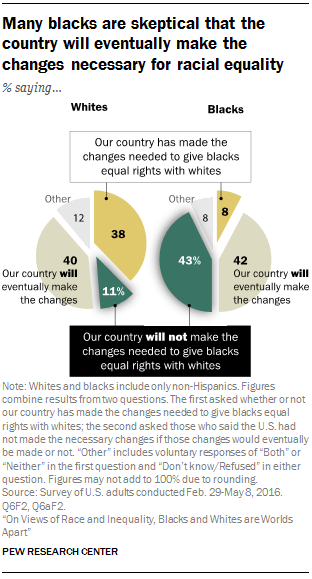
An overwhelming majority of blacks (88%) say the country needs to go on making changes for blacks to accept equal rights with whites, but 43% are skeptical that such changes will always occur. An boosted 42% of blacks believe that the state will eventually make the changes needed for blacks to have equal rights with whites, and merely eight% say the country has already made the necessary changes.
A much lower share of whites (53%) say the country still has work to do for blacks to achieve equal rights with whites, and only 11% express doubt that these changes will come. 4-in-ten whites believe the country volition eventually make the changes needed for blacks to take equal rights, and well-nigh the same share (38%) say enough changes take already been made.
These findings are based on a national survey by Pew Research Heart conducted Feb. 29-May 8, 2016, amid 3,769 adults (including 1,799 whites, i,004 blacks and 654 Hispanics).2 The survey – and the analysis of the survey findings – is centered primarily around the split up between blacks and whites and on the treatment of black people in the U.S. today. In recent years, this centuries-sometime dissever has garnered renewed attending following the deaths of unarmed black Americans during encounters with the police, likewise as a racially motivated shooting that killed nine black parishioners at a church in Charleston, South Carolina, in 2015.
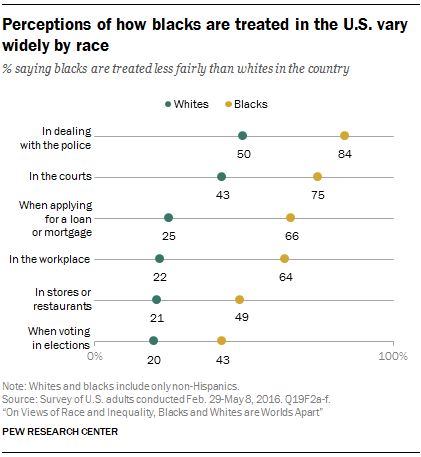
The survey finds that blackness and white adults have widely different perceptions near what life is like for blacks in the U.S. For example, past large margins, blacks are more likely than whites to say black people are treated less fairly in the workplace (a difference of 42 pct points), when applying for a loan or mortgage (41 points), in dealing with the police (34 points), in the courts (32 points), in stores or restaurants (28 points), and when voting in elections (23 points). By a margin of at least 20 percentage points, blacks are also more likely than whites to say racial discrimination (lxx% vs. 36%), lower quality schools (75% vs. 53%) and lack of jobs (66% vs. 45%) are major reasons that blacks may take a harder fourth dimension getting ahead than whites.
More broadly, blacks and whites offering different perspectives of the current land of race relations in the U.S. White Americans are evenly divided, with 46% maxim race relations are generally good and 45% saying they are generally bad. In contrast, by a near ii-to-one margin, blacks are more than probable to say race relations are bad (61%) rather than good (34%). Blacks are as well near twice as probable as whites to say too picayune attending is paid to race and racial bug in the U.S. these days (58% vs. 27%). Well-nigh 4-in-x whites (41%) – compared with 22% of blacks – say there is too much focus on race and racial issues.
Blacks and whites likewise differ in their opinions about the all-time arroyo for improving race relations: Among whites, more than twice equally many say that in order to improve race relations, it's more of import to focus on what different racial and ethnic groups have in common (57%) equally say the focus should be on what makes each group unique (26%). Among blacks, similar shares say the focus should be on commonalities (45%) as say information technology should be on differences (44%).
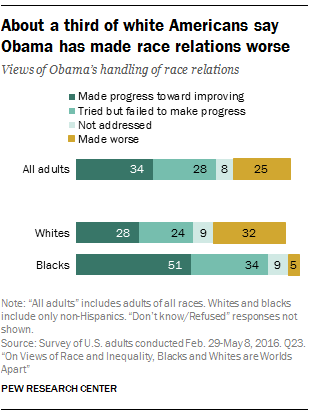
When asked specifically near the impact President Barack Obama has had on race relations in the U.S., a majority of Americans requite the president credit for at least trying to make things meliorate, but a quarter say he has fabricated race relations worse. Blacks and whites differ significantly in their assessments. Some 51% of blacks say Obama has made progress toward improving race relations, and an additional 34% say he has tried but failed to make progress. Relatively few blacks (5%) say Obama has made race relations worse, while ix% say he hasn't addressed the consequence at all.
Amongst whites, 28% say Obama has fabricated progress toward improving race relations and 24% say he has tried but failed to make progress. But a substantial share of whites (32%) say Obama has made race relations worse. This is driven largely by the views of white Republicans, 63% of whom say Obama has made race relations worse (compared with just v% of white Democrats).
When asked about their views of Black Lives Matter, the activist motion that first came to national prominence following the 2014 shooting decease of an unarmed black 18-yr-erstwhile by a white constabulary officer in Ferguson, Missouri, roughly two-thirds (65%) of blacks limited back up, including 41% who strongly support it. Amongst whites, four-in-ten say they support the Black Lives Move at least somewhat, and this is particularly the case among white Democrats and those younger than 30.
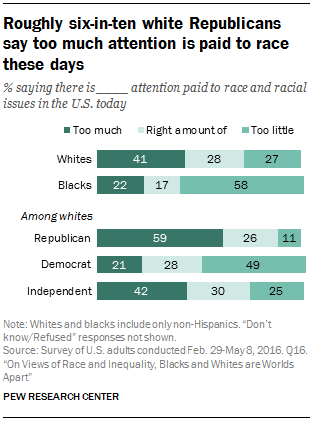
Across the survey's findings, there are pregnant mistake lines within the white population – perhaps none more consistent than the partisan divide. For example, among whites, Democrats and Republicans differ dramatically on the very salience of race issues in this country. Near vi-in-10 (59%) white Republicans say besides much attention is paid to race and racial issues these days, while only 21% of Democrats agree. For their role, a 49% plurality of white Democrats say too little attention is paid to race these days, compared with only 11% of Republicans.
And while virtually viii-in-ten (78%) white Democrats say the country needs to go along making changes to reach racial equality between whites and blacks, simply 36% of white Republicans concord; 54% of white Republicans believe the country has already fabricated the changes necessary for blacks to take equal rights with whites.
The economic realities of black and white households
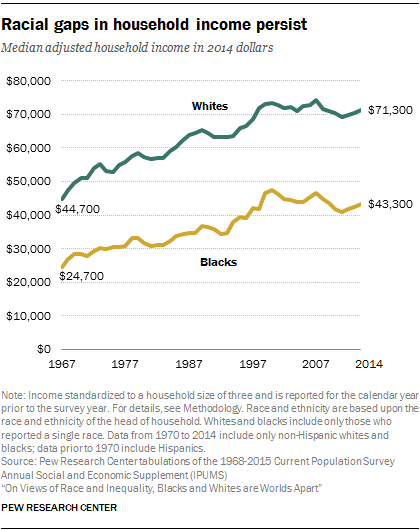
Trends in key economic and demographic indicators provide some context for the experiences and outlook of blacks today. While in that location has been clear progress in closing the white-blackness gap in some areas – particularly when information technology comes to high school completion rates – decades-old black-white gaps in economic well-existence persist and accept even widened in some cases.
According to a new Pew Research Center analysis of information from the U.S. Census Agency, in 2014 the median adapted income for households headed past blacks was $43,300, and for whites it was $71,300. 3 Blacks also lag behind whites in college completion, only even amid adults with a bachelor's degree, blacks earned significantly less in 2014 than whites ($82,300 for households headed by a college-educated blackness compared with $106,600 for comparable white households).
The racial gap extends to household wealth – a measure where the gap has widened since the Great Recession. In 2013, the well-nigh contempo year available, the median net worth of households headed by whites was roughly thirteen times that of black households ($144,200 for whites compared with $eleven,200 for blacks).
For nearly Americans, household wealth is closely tied to dwelling house equity, and there are sharp and persistent gaps in homeownership between blacks and whites. In 2015, 72% of white household heads endemic a home, compared with 43% of black household heads.
And on the flipside of wealth – poverty – racial gaps persist, even though the poverty charge per unit for blacks has come up downward significantly since the mid-1980s. Blacks are still more than than twice as likely as whites to be living in poverty (26% compared with x% in 2014).
Blacks and whites are divided on reasons that blacks may exist struggling to get ahead
Despite these economic realities, when asked nigh the financial situation of blacks compared with whites today, about four-in-10 blacks either say that both groups are about equally well off (30%) or that blacks are improve off than whites financially (viii%). Even so, well-nigh half-dozen-in-10 (58%) blacks say that, as a group, they are worse off than whites.
Amidst whites, a plurality (47%) say blacks are worse off financially, while 37% say blacks are about too off as whites and 5% say blacks are doing meliorate than whites.
Blacks and whites with a bachelor'due south degree are more probable than those with less teaching to say blacks are worse off financially than whites these days. Roughly eight-in-ten (81%) blacks with a four-year higher degree say this, compared with 61% of blacks with only some college educational activity and 46% of blacks with a high schoolhouse diploma or less. In a similar pattern, about ii-thirds (66%) of white college graduates say blacks are worse off financially than whites, while fewer among those who attended college but did not receive a degree (47%) and those who did not attend college (29%) say the same.
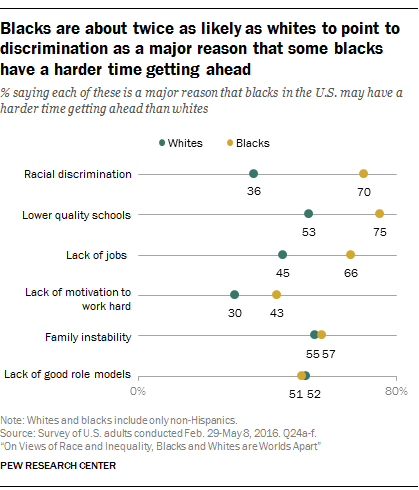
When asked well-nigh the underlying reasons that blacks may be having a harder time getting ahead than whites, large majorities of black adults betoken to societal factors. Two-thirds or more blacks say failing schools (75%), racial discrimination (lxx%) and a lack of jobs (66%) are major reasons that black people may have a harder time getting ahead these days.
On each of these items, the views of blacks differ significantly from those of whites. Merely, past far, the biggest gap comes on racial bigotry, where only 36% of whites say this is a major reason that blacks may be struggling to get alee, 34 percentage points lower than the share of blacks who say the same.
The views of blacks and whites are more closely aligned when it comes to the touch on that family instability (57% and 55%, respectively) and a lack of good role models (51% and 52%) has on black progress. However, the relative ranking of these items varies among blacks and whites. While whites rank family instability and a lack of skillful function models higher up or on a par with societal factors as major reasons that blacks may have a harder time getting ahead than whites, fewer blacks say these items are major reasons than say the same about lower quality schools, bigotry, and lack of jobs.
Blacks are more than likely than whites to say a lack of motivation to work hard may be belongings blacks dorsum: 43% of black adults and 30% of whites say this is a major reason blacks are having a harder time getting ahead than whites. 4
More than whites and blacks say individual discrimination is a bigger problem than institutional racism
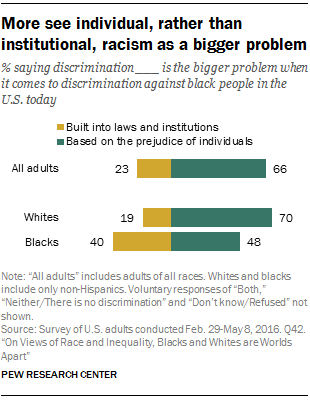
On balance, the public thinks that when information technology comes to discrimination confronting black people in the U.Southward. today, bigotry that is based on the prejudice of individual people is a bigger trouble than discrimination that is built into the nation's laws and institutions. This is the case among both blacks and whites, but while whites offer this opinion by a large margin (seventy% to 19%), blacks are more evenly divided (48% to forty%).
Still, big majorities of black adults say that blacks in this land are treated unfairly in a range of institutional settings – from the criminal justice system, to the workplace to banks and fiscal institutions.
Fully 84% of blacks say that blackness people in this land are treated less fairly than whites in dealing with the police force, and iii-quarters say blacks are treated less fairly in the courts.
Roughly two-thirds of black adults say that blacks are treated less fairly than whites when applying for a loan or mortgage (66%) and in the workplace (64%). Somewhat smaller shares – though still upwards of four-in-ten – run into unfair treatment for blacks in stores and restaurants (49%) and when voting in elections (43%).
Across all of these realms, whites are much less likely than blacks to perceive unequal treatment – with differences ranging from 23 to 42 pct points.
Personal experiences with discrimination
A majority of blacks (71%) say that they have experienced discrimination or been treated unfairly because of their race or ethnicity. Roughly one-in-ten (xi%) say this happens to them on a regular ground, while 60% say they have experienced this rarely or from time to time.
Among blacks, men and women are equally probable to written report having personally experienced racial discrimination, and there are no large gaps by age. There is an educational divide, however: Blacks with at least some college experience (81%) are much more likely than blacks who never attended college (59%) to say they have been discriminated confronting because of their race.
Experiences with racial discrimination are far less common among whites, but a sizable minority (30%) of white adults report that they have been discriminated against or treated unfairly because of their race or ethnicity. Only 2% say this happens to them regularly and 28% say it occurs less frequently. Whites who say they take a lot of contact with blacks are more likely to say they've been discriminated confronting because of their race than are whites who have less contact with blacks.
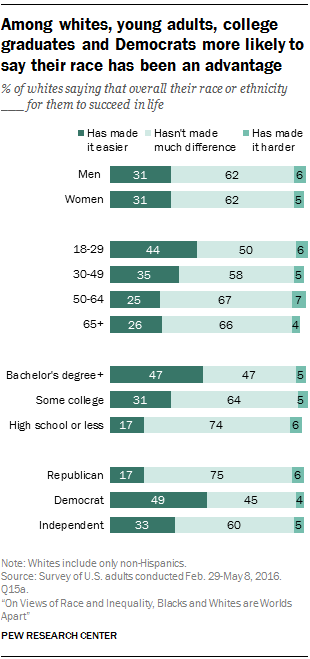
While some whites study being treated unfairly at times because of their race, the overall impact is relatively minor. Only 5% of whites say their race or ethnicity has fabricated it harder for them to succeed in life. A majority of whites (62%) say their race hasn't made much of difference in their power to succeed, and 31% say their race has made things easier for them.
College-educated whites are especially probable to see their race as an advantage: 47% say being white has made information technology easier for them to succeed. By comparison, 31% of whites with some college education and 17% of those with a high school diploma or less say their race has made things easier for them. White Democrats (49%) are too amid the virtually likely to say that their race or ethnicity has made it easier for them to get alee in life.
For many blacks, the cumulative impact of bigotry has had a markedly negative impact on their lives. Four-in-ten blacks say their race has made information technology harder for them to succeed in life. Roughly half (51%) say their race hasn't made a divergence in their overall success, and simply eight% say being blackness has made things easier.
At that place is a sharp educational divide among blacks on the overall impact their race has had on their power to succeed. Fully 55% of blacks with a four-year college degree say their race has fabricated it harder for them to succeed in life. Some 45% of blacks who attended college merely did not receive a bachelor'south caste say the aforementioned. Amid blacks with a high school education or less, a far lower share (29%) say their race has made it harder for them to succeed. A majority of this grouping (threescore%) say their race hasn't made a difference.
Nearly half of blacks say people accept acted like they were suspicious of them
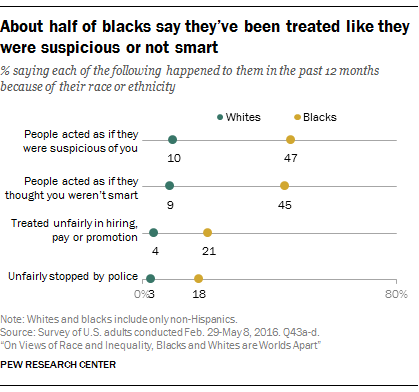
Unfair treatment tin can come in different forms. Roughly half of blacks (47%) say that in the past 12 months someone has acted as if they were suspicious of them because of their race or ethnicity. Many blacks likewise written report feeling like others have questioned their intelligence. Some 45% say that in the past 12 months people have treated them as if they were not smart because of their race or ethnicity.
Roughly one-in-five blacks (21%) say they have been treated unfairly by an employer in the past year because of their race or ethnicity, and a similar share (18%) study having been unfairly stopped by the police during this period.
Black men are more than likely than blackness women to say that people have treated them with suspicion (52% vs. 44%). And they are more likely to say they have been unfairly stopped by the police (22% vs. fifteen%).
Being treated with suspicion and being treated as if they are not intelligent are more common experiences for blackness adults who attended college than for those who did non. For example, 52% of those with at least some college educational activity say that, in the by 12 months, someone has treated them every bit if they thought they weren't smart because of their race or ethnicity, compared with 37% of those with a high schoolhouse diploma or less.
Amongst blacks, widespread support for the Black Lives Matter movement
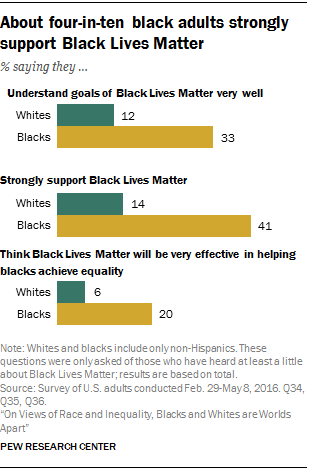
Nigh blacks (65%) express back up for the Black Lives Matter movement: 41% strongly support information technology, and 24% say they back up it somewhat. Some 12% of blacks say they oppose Black Lives Matter (including 4% who strongly oppose it). Even so, blacks have somewhat mixed views about the extent to which the Blackness Lives Matter move volition be effective, in the long run, in helping blacks reach equality. Nigh (59%) think it volition be effective, but simply 20% think information technology volition exist very effective. Nigh one-in-5 (21%) say it won't be as well constructive or won't be effective at all in the long run.
Blacks with a available'south degree or more are among the near skeptical that the Black Lives Matter motility will ultimately assist bring nigh racial equality. Nigh iii-in-ten (31%) of those with a available's degree or more education say that, in the long run, the movement won't exist too constructive or won't be effective at all, compared with nearly ii-in-x adults with less education.
Granted, many blacks are skeptical overall that the country will eventually make the changes needed to bring virtually racial equality. But even among those who think change volition eventually come, only 23% say Blackness Lives Matter will exist very effective in helping bring virtually equality.
For their office, whites have mixed views of the Black Lives Thing motion. 4-in-ten whites say they support the movement (14% strongly support and 26% somewhat support). And near a tertiary (34%) of whites say, in the long run, the Black Lives Matter movement will be at least somewhat effective in helping blacks achieve equality.
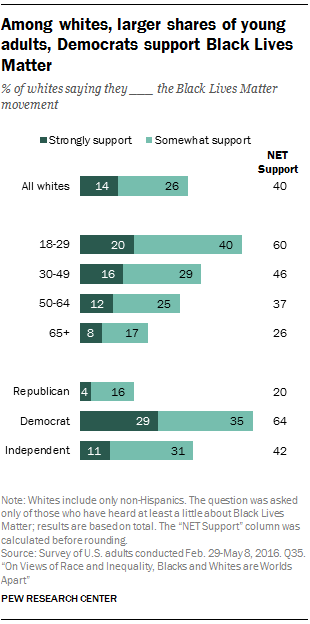
Young white adults are more enthusiastic nearly Black Lives Thing than centre-anile and older whites. Six-in-ten of those ages 18 to 29 say they support it, compared with 46% of whites ages thirty to 49, 37% of whites ages fifty to 64, and 26% of whites 65 and older. Young whites are also somewhat more likely than their older counterparts to say that the Blackness Lives Matter motility will exist at least somewhat effective in the long run (47% vs. 37%, 32% and 26%, respectively).
Whites' views on Black Lives Matter besides differ significantly by party identification. Some 64% of white Democrats back up the motility, including 29% who do so strongly. One-in-five white Republicans and 42% of white independents say they support the Blackness Lives Thing movement (4% of Republicans and eleven% of independents strongly support it). White Democrats are as well much more likely than Republicans and independents to say that the movement will ultimately be at to the lowest degree somewhat constructive in bringing about racial equality (53% vs. 20% and 34%, respectively).
When asked how well they feel they understand the goals of the Blackness Lives Affair movement, blacks are much more than likely than whites to say they understand it very or fairly well. Even so, near one-in-five blacks (xix%) say they don't have a good understanding of its goals, compared with 29% of whites. But full general awareness of Black Lives Matter is widespread amidst whites and blacks: Overall, 81% of blacks and 76% of whites have heard at least a picayune almost the movement, including about one-half or more of each group (56% and 48%, respectively), who say they have heard a lot.
Many blacks and whites say community appointment is key to bringing about racial equality
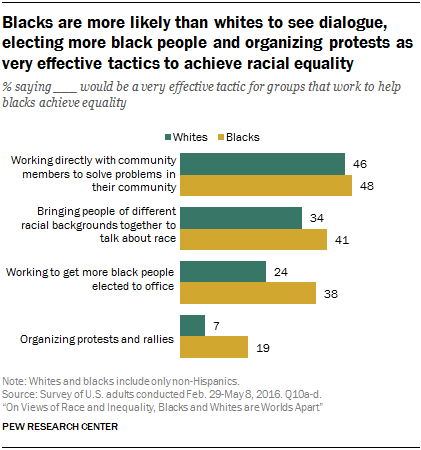
More 4-in-ten blacks (48%) and whites (46%) say that working with community members to solve issues in their community would exist a very constructive tactic for groups striving to assist blacks achieve equality. But the two groups disagree most the effectiveness of another tactics.
In particular, while about four-in-10 (38%) black adults say working to go more black people elected to office would be very effective, simply 24% of whites say the same. Blacks are also more likely than whites to say it would exist very effective for groups working to help blacks achieve equality to bring people of different racial backgrounds together to talk nearly race (41% vs. 34%). Similarly, blacks see more value than whites in organizing protests and rallies, although relatively few blacks view this as a very effective fashion to bring well-nigh change (nineteen% vs. seven% of whites).
The balance of this report examines in greater detail the public'southward views of the land of race relations and racial inequality in the U.S. Chapter ane looks at some key demographic and economic indicators where blacks have made progress or lag behind other racial and indigenous groups. Chapter 2 focuses on views about the current state of race relations and its trajectory, as well as the chore Obama has done on this issue. Affiliate 3 examines the extent to which Americans think the state has made – or will eventually make – the changes necessary for blacks to achieve equal rights with whites. It also looks at perceptions well-nigh the way blacks and whites are treated across many realms of American life. Affiliate four focuses on what the public sees equally constructive strategies for groups and organizations working to promote racial equality and explores attitudes toward the Black Lives Affair move and other organizations that strive to bring about equality for black Americans. Chapter 5 looks at personal experiences with discrimination every bit well as perceptions about the impact race and gender have had in one's life. Chapter six describes the outlook and experiences of blacks, whites and Hispanics, particularly as they relate to personal finances.
Other central findings
- Almost one-half (48%) of whites say they are very satisfied with the quality of life in their community, compared with almost a tertiary (34%) of blacks. This gap persists after controlling for income. For instance, 57% of whites with an annual family unit income of $75,000 or more than study that they are very satisfied with the quality of life in their community; just 38% of blacks in the same income group say the aforementioned.
- Blacks are far more likely than whites to say they accept experienced financial hardship in the past 12 months. About four-in-x (41%) blacks say they take had problem paying their bills, and well-nigh a quarter (23%) say they have gotten food from a food depository financial institution or food pantry during this flow. Among whites, 25% say they have struggled to pay their bills, and viii% written report having sought out nutrient from a nutrient bank in the past 12 months.
- Black men are far more than likely than white men to say their gender has made information technology harder for them to get ahead in life (twenty% vs. v%, respectively). Amid women, similar shares of blacks (28%) and whites (27%) say their gender has set them back.
- About eight-in-ten (81%) blacks say they feel at least somewhat connected to a broader black customs in the U.S., including 36% who feel very connected. Blacks who feel a strong sense of connection to a broader blackness customs are more probable than those who don't to say that in the by 12 months they accept fabricated a financial contribution to, attended an consequence sponsored by, or volunteered their time to a grouping or organization working specifically to improve the lives of blackness Americans.
- Majorities of blacks say the NAACP (77%), the National Urban League (66%) and the Congressional Black Caucus (63%) have been at least somewhat constructive in helping blacks achieve equality in this country. Only nigh three-in-10 or fewer say each of these groups has been very constructive, likely reflecting, at least in part, the widespread view among blacks that the country has work to do for blacks to achieve equal rights with whites.
References to whites, blacks and Asians include just those who are non-Hispanic, unless otherwise noted, and identify themselves every bit merely one race. Hispanics are of any race. In Chapter 1, references to whites and blacks for survey years prior to 1971 include Hispanics.
Throughout this written report, references to college graduates or people with a college degree incorporate those with a bachelor's degree or more. "Some college" refers to those with a two-twelvemonth degree or those who attended college but did non obtain a degree. "Loftier schoolhouse" refers to those who have attained a high school diploma or its equivalent, such as a General Education Development (GED) certificate.
Source: https://www.pewresearch.org/social-trends/2016/06/27/on-views-of-race-and-inequality-blacks-and-whites-are-worlds-apart/

Post a Comment for "Discrimination Again People of Lower Degrees"