United Nation Coastal Fisheries Outrigger Canoe Plan Reviews

Stilts fishermen, Sri Lanka

Fishing with nets, Mexico
Fishing is the activeness of trying to grab fish. Fish are often caught in the wild but may as well be caught from stocked bodies of water. Techniques for catching fish include hand gathering, spearing, netting, angling and trapping. "Angling" may include communicable aquatic animals other than fish, such as molluscs, crustaceans, and echinoderms (such as starfish and body of water urchins). The term is not normally practical to communicable farmed fish, or to aquatic mammals, such as whales where the term whaling is more appropriate. In improver to being defenseless to be eaten, fish are caught as recreational pastimes. Fishing tournaments are held, and caught fish are sometimes kept equally preserved or living trophies. When bioblitzes occur, fish are typically caught, identified, and then released.
Co-ordinate to the United nations FAO statistics, the total number of commercial fishers and fish farmers is estimated to be 38 million. Fisheries and aquaculture provide direct and indirect employment to over 500 meg people in developing countries.[1] In 2005, the worldwide per capita consumption of fish captured from wild fisheries was 14.four kilograms (32 lb), with an additional vii.4 kilograms (16 lb) harvested from fish farms.[ii]
History [edit]
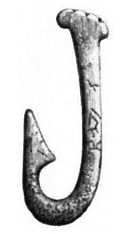
Fishing is an ancient practise that dates back to at least the start of the Upper Paleolithic period about twoscore,000 years ago.[3] Isotopic analysis of the remains of Tianyuan man, a 40,000-yr-old mod human from east asia, has shown that he regularly consumed freshwater fish.[4] [5] Archæology features such as shell middens,[6] discarded fish bones, and cavern paintings show that sea foods were important for survival and consumed in significant quantities. Fishing in Africa is evident very early on in human history. Neanderthals were line-fishing past nearly 200,000 BC.[seven] People could have developed basketry for fish traps, and spinning and early on forms of knitting in club to make line-fishing nets[8] to be able to take hold of more than fish in larger quantities.
During this catamenia, almost people lived a hunter-gatherer lifestyle and were, of necessity, constantly on the move. However, where in that location are early examples of permanent settlements (though not necessarily permanently occupied) such equally those at Lepenski Vir, they are almost ever associated with line-fishing as a major source of food.
Trawling [edit]
The British dogger was a very early blazon of sailing trawler from the 17th century, but the mod fishing trawler was adult in the 19th century, at the English fishing port of Brixham. By the early 19th century, the fishers at Brixham needed to expand their line-fishing area further than ever earlier due to the ongoing depletion of stocks that was occurring in the overfished waters of South Devon. The Brixham trawler that evolved there was of a sleek build and had a tall gaff rig, which gave the vessel sufficient speed to brand long-distance trips out to the fishing grounds in the sea. They were also sufficiently robust to be able to tow big trawls in deep water. The dandy trawling fleet that built upward at Brixham earned the village the title of 'Mother of Deep-sea Fisheries'.[9]

This revolutionary blueprint made large scale trawling in the ocean possible for the first time, resulting in a massive migration of fishers from the ports in the Due south of England, to villages further north, such as Scarborough, Hull, Grimsby, Harwich and Yarmouth, that were points of access to the large fishing grounds in the Atlantic Ocean.[9]
The small village of Grimsby grew to go the largest fishing port in the world[10] by the mid 19th century. An Human activity of Parliament was first obtained in 1796, which authorised the construction of new quays and dredging of the Haven to make it deeper.[11] Information technology was simply in 1846, with the tremendous expansion in the fishing industry, that the Grimsby Dock Company was formed. The foundation stone for the Purple Dock was laid by Albert the Prince consort in 1849. The dock covered 25 acres (10 ha) and was formally opened by Queen Victoria in 1854 as the first modern fishing port.
The elegant Brixham trawler spread beyond the world, influencing angling fleets everywhere.[12] Past the end of the 19th century, there were over three,000 fishing trawlers in commission in Britain, with near 1,000 at Grimsby. These trawlers were sold to fishers around Europe, including from the netherlands and Scandinavia. Twelve trawlers went on to course the nucleus of the German angling armada.[13]
The earliest steam-powered line-fishing boats first appeared in the 1870s and used the trawl system of fishing every bit well as lines and drift nets. These were large boats, ordinarily 80–xc feet (24–27 m) in length with a axle of around twenty feet (6.ane m). They weighed 40–fifty tons and travelled at 9–11 knots (17–20 km/h; 10–13 mph). The earliest purpose-built fishing vessels were designed and made past David Allan in Leith, Scotland in March 1875, when he converted a drifter to steam power. In 1877, he congenital the first spiral propelled steam trawler in the world.[xiv]
Steam trawlers were introduced at Grimsby and Hull in the 1880s. In 1890 it was estimated that there were xx,000 men on the N Sea. The steam drifter was not used in the herring fishery until 1897. The last sailing fishing trawler was built in 1925 in Grimsby. Trawler designs adapted every bit the fashion they were powered changed from canvas to coal-fired steam by World War I to diesel and turbines by the end of World State of war Two.
In 1931, the first powered drum was created past Laurie Jarelainen. The pulsate was a circular device that was set to the side of the boat and would describe in the nets. Since World State of war II, radio navigation aids and fish finders have been widely used. The first trawlers fished over the side, rather than over the stern. The showtime purpose-built stern trawler was Fairtry congenital-in 1953 at Aberdeen, Scotland. The ship was much larger than any other trawlers then in functioning and inaugurated the era of the 'super trawler'. As the ship pulled its nets over the stern, it could lift out a much greater haul of up to sixty tons.[fifteen] The ship served as a basis for the expansion of 'super trawlers' around the globe in the following decades.[xv]
Recreational fishing [edit]

The early on development of line-fishing as recreation is non articulate. For example, in that location is anecdotal evidence for wing angling in Japan, however, fly fishing was likely to have been a means of survival, rather than recreation. The earliest English essay on recreational fishing was published in 1496, past Dame Juliana Berners, the prioress of the Benedictine Sopwell Nunnery. The essay was titled Treatyse of Fysshynge wyth an Angle,[16] and included detailed data on fishing waters, the construction of rods and lines, and the use of natural baits and artificial flies.[17]
Recreational angling took a groovy leap forrard later the English Civil State of war, where a newly found involvement in the activity left its mark on the many books and treatises that were written on the subject at the fourth dimension. Leonard Mascall in 1589 wrote A booke of Fishing with Hooke and Line along with many others he produced in his life on game and wild fauna in England at the time. The Compleat Angler was written past Izaak Walton in 1653 (although Walton continued to add to it for a quarter of a century) and described the angling in the Derbyshire Wye. Information technology was a celebration of the art and spirit of line-fishing in prose and verse. A 2d role to the book was added past Walton's friend Charles Cotton fiber.[18]
Charles Kirby designed an improved fishing hook in 1655 that remains relatively unchanged to this 24-hour interval. He went on to invent the Kirby curve, a distinctive hook with an outset point, notwithstanding commonly used today.[19]

Trading card of the Ustonson visitor, an early business firm specializing in fishing equipment, and holder of a Majestic Warrant from the 1760s.
The 18th century was mainly an era of consolidation of the techniques developed in the previous century. Running rings began to appear along the angling rods, which gave anglers greater control over the cast line. The rods themselves were also becoming increasingly sophisticated and specialised for dissimilar roles. Jointed rods became mutual from the eye of the century and bamboo came to be used for the top section of the rod, giving it a much greater strength and flexibility.
The industry also became commercialised – rods and tackle were sold at the haberdashers store. After the Swell Fire of London in 1666, artisans moved to Redditch which became a centre of production of fishing related products from the 1730s. Onesimus Ustonson established his shop in 1761, and his establishment remained as a market leader for the next century. He received a Majestic Warrant from three successive monarchs starting with King George 4.[20] He also invented the multiplying winch. The commercialization of the industry came at a time of expanded interest in angling equally a recreational hobby for members of the aristocracy.[21]
The impact of the Industrial Revolution was first felt in the manufacture of fly lines. Instead of anglers twisting their lines – a laborious and time-consuming process – the new textile spinning machines allowed for a variety of tapered lines to exist hands manufactured and marketed.
British wing-fishing continued to develop in the 19th Century, with the emergence of wing line-fishing clubs, along with the appearance of several books on the subject of fly tying and fly fishing techniques.
By the mid to late 19th century, expanding leisure opportunities for the centre and lower classes began to have its effect on wing line-fishing, which steadily grew in mass appeal. The expansion of the railway network in Britain immune the less affluent for the commencement fourth dimension to take weekend trips to the seaside or rivers for fishing. Richer hobbyists ventured further abroad.[22] The large rivers of Kingdom of norway replete with large stocks of salmon began to attract fishers from England in large numbers in the middle of the century – Jones's guide to Kingdom of norway, and salmon-fisher's pocket companion, published in 1848, was written by Frederic Tolfrey and was a pop guide to the land.[22]

'Nottingham' and 'Scarborough' reel designs.
Modern reel design had begun in England during the latter part of the 18th century, and the predominant model in use was known as the 'Nottingham reel'. The reel was a wide drum that spooled out freely and was ideal for allowing the bait to drift a long manner out with the current. Geared multiplying reels never successfully caught on in Britain, but had more success in the United States, where similar models were modified past George Snyder of Kentucky into his bait-casting reel, the first American-made design in 1810.[23]
The fabric used for the rod itself changed from the heavy woods native to England to lighter and more elastic varieties imported from abroad, especially from South America and the Westward Indies. Bamboo rods became the mostly favoured option from the mid 19th century, and several strips of the material were cut from the pikestaff, milled into shape, and then glued together to course the lite, strong, hexagonal rods with a solid core that were superior to anything that preceded them. George Cotton and his predecessors fished their flies with long rods, and light lines assuasive the wind to do most of the work of getting the fly to the fish.[24]

Line-fishing became a popular recreational activity in the 19th century. Print from Currier and Ives.
Tackle design began to improve from the 1880s. The introduction of new forest to the manufacture of fly rods fabricated information technology possible to cast flies into the wind on silk lines, instead of horse pilus. These lines allowed for a much greater casting distance. However, these early on fly lines proved troublesome as they had to be coated with diverse dressings to make them float and needed to be taken off the reel and dried every iv hours or so to preclude them from becoming waterlogged. Some other negative consequence was that information technology became easy for the much longer line to get into a tangle – this was called a 'tangle' in U.k., and a 'backfire' in the Us. This trouble spurred the invention of the regulator to evenly spool the line out and prevent tangling.[24]
The American, Charles F. Orvis, designed and distributed a novel reel and wing design in 1874, described by reel historian Jim Brown every bit the "criterion of American reel design," and the first fully modern wing reel.[25] [26]
Albert Illingworth, 1st Baron Illingworth a textiles magnate, patented the modern form of stock-still-spool spinning reel in 1905. When casting Illingworth's reel design, the line was drawn off the leading border of the spool but was restrained and rewound by a line pickup, a device which orbits around the stationary spool. Considering the line did not have to pull against a rotating spool, much lighter lures could exist cast than with conventional reels.[24]
The development of inexpensive fiberglass rods, synthetic fly lines, and monofilament leaders in the early on 1950s, that revived the popularity of wing angling.
Techniques [edit]
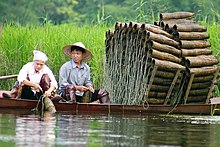
Fishermen with traditional fish traps, Vietnam
There are many fishing techniques and tactics for catching fish. The term can also be applied to methods for catching other aquatic animals such as molluscs (shellfish, squid, octopus) and edible marine invertebrates.
Fishing techniques include manus gathering, spearfishing, netting, angling and trapping. Recreational, commercial and artisanal fishers use unlike techniques, and also, sometimes, the same techniques. Recreational fishers fish for pleasance, sport, or to provide nutrient for themselves, while commercial fishers fish for profit. Artisanal fishers use traditional, low-tech methods, for survival in third-world countries, and as a cultural heritage in other countries. Usually, recreational fishers utilize angling methods and commercial fishers use netting methods. A modern development is to fish with the assistance of a drone.[27]
Why a fish bites a baited hook or lure involves several factors related to the sensory physiology, behaviour, feeding ecology, and biology of the fish too every bit the environment and characteristics of the allurement/hook/lure.[28] In that location is an intricate link between diverse fishing techniques and cognition about the fish and their behaviour including migration, foraging and habitat. The effective employ of fishing techniques often depends on this boosted noesis.[29] Some fishers follow fishing folklores which claim that fish feeding patterns are influenced by the position of the sun and the moon.
Tackle [edit]
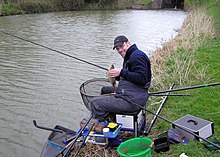
Fishing tackle is the equipment used past fishers when fishing. Well-nigh whatsoever equipment or gear used for fishing can be called fishing tackle. Some examples are hooks, lines, sinkers, floats, rods, reels, baits, lures, spears, nets, gaffs, traps, waders and tackle boxes.
Tackle that is fastened to the end of a fishing line is chosen final tackle. This includes hooks, sinkers, floats, leaders, swivels, split rings and wire, snaps, beads, spoons, blades, spinners and clevises to attach spinner blades to fishing lures. People also tend to utilize expressionless or live fish as another form of bait.
Line-fishing tackle refers to the concrete equipment that is used when fishing, whereas fishing techniques refers to the means the tackle is used when fishing.
Angling vessels [edit]

Commercial crab boat working in the North Sea

A fishing vessel is a boat or ship used to grab fish in the bounding main, or on a lake or river. Many different kinds of vessels are used in commercial, artisanal and recreational angling.
Co-ordinate to the FAO, in 2004 there were four 1000000 commercial fishing vessels.[30] Most ane.3 million of these are decked vessels with enclosed areas. Virtually all of these decked vessels are mechanised, and forty,000 of them are over 100 tons. At the other farthermost, two-thirds (ane.8 meg) of the undecked boats are traditional arts and crafts of various types, powered just by sheet and oars.[30] These boats are used by artisan fishers.
It is difficult to judge how many recreational fishing boats there are, although the number is loftier. The term is fluid since some recreational boats may besides exist used for fishing from time to time. Unlike most commercial line-fishing vessels, recreational fishing boats are frequently not defended just to fishing. Just about anything that volition stay afloat tin exist called a recreational fishing boat, and so long as a fisher periodically climbs aboard with the intent to catch a fish. Fish are caught for recreational purposes from boats which range from dugout canoes, bladder tubes, kayaks, rafts, stand paddleboards, pontoon boats and pocket-sized dinghies to runabouts, cabin cruisers and cruising yachts to large, hi-tech and luxurious big game rigs.[31] Larger boats, purpose-congenital with recreational fishing in mind, usually have large, open cockpits at the stern, designed for user-friendly fishing.
Traditional fishing [edit]
Traditional line-fishing is any kind of minor scale, commercial or subsistence fishing practices using traditional techniques such equally rod and tackle, arrows and harpoons, throw nets and elevate nets, etc.
Recreational fishing [edit]


Recreational and sport fishing are fishing primarily for pleasure or competition. Recreational fishing has conventions, rules, licensing restrictions and laws that limit how fish may be defenseless; typically, these prohibit the use of nets and the catching of fish with hooks non in the oral cavity. The most common form of recreational fishing is done with a rod, reel, line, hooks and whatsoever 1 of a wide range of baits or lures such as artificial flies. The practise of communicable or attempting to catch fish with a hook is generally known as angling. In angling, information technology is sometimes expected or required that fish be returned to the water (catch and release). Recreational or sport fishermen may log their catches or participate in line-fishing competitions.
The estimated global number of recreational fishers varies from 220 1000000 to a maximum number of 700 one thousand thousand fishers globally,[32] which is thought to be double the amount of individuals working equally commercial fishers. In the United States alone it was estimated that 50.ane one thousand thousand people engaged in line-fishing activities in both saltwater and freshwater environments.[33]
Large-game fishing is fishing from boats to grab large open-water species such as tuna, sharks, and marlin. Sportfishing (sometimes game fishing) is recreational fishing where the master reward is the claiming of finding and communicable the fish rather than the culinary or fiscal value of the fish's mankind. Fish sought after include tarpon, sailfish, mackerel and many others.
Angling manufacture [edit]
-
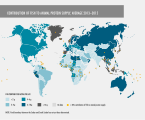
Contribution of fish to animate being poly peptide supply, average 2013-2015
-

World capture fisheries and aquaculture product 1950 - 2015

The fishing industry includes any industry or activity concerned with taking, culturing, processing, preserving, storing, transporting, marketing or selling fish or fish products. It is defined by the FAO equally including recreational, subsistence and commercial fishing, and the harvesting, processing, and marketing sectors.[34] The commercial activity is aimed at the delivery of fish and other seafood products for human consumption or use every bit raw material in other industrial processes.
In that location are three main industry sectors:[note ane]
- The commercial sector comprises enterprises and individuals associated with wild-catch or aquaculture resources and the various transformations of those resources into products for sale.
- The traditional sector comprises enterprises and individuals associated with fisheries resource from which aboriginal people derive products following their traditions.
- The recreational sector comprises enterprises and individuals associated with the purpose of recreation, sport or sustenance with fisheries resources from which products are derived that are non for sale.
Commercial fishing [edit]

Fishing gunkhole in heavy sea
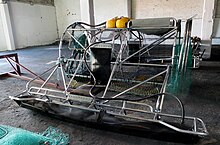
Commercial fishing is the capture of fish for commercial purposes. Those who practice information technology must often pursue fish far from the country under adverse conditions. Commercial fishermen harvest almost all aquatic species, from tuna, cod and salmon to shrimp, krill, lobster, clams, squid and crab, in various fisheries for these species. Commercial angling methods take get very efficient using big nets and sea-going processing factories. Individual angling quotas and international treaties seek to control the species and quantities caught.
A commercial fishing enterprise may vary from one human with a small boat with hand-casting nets or a few pot traps, to a huge fleet of trawlers processing tons of fish every day.
Commercial fishing gear includes weights, nets (e.g. purse seine), seine nets (east.g. embankment seine), trawls (e.g. bottom trawl), dredges, hooks and line (e.g. long line and handline), lift nets, gillnets, entangling nets and traps.
According to the Food and Agriculture Organization of the United nations, the full globe capture fisheries production in 2000 was 86 1000000 tons (FAO 2002). The peak producing countries were, in gild, the People'southward Republic of People's republic of china (excluding Hong Kong and Taiwan), Republic of peru, Japan, the United States, Chile, Indonesia, Russia, India, Thailand, Norway, and Iceland. Those countries accounted for more than half of the world's production; China alone accounted for a third of the world's production. Of that production, over 90% was marine and less than 10% was inland.
A small number of species support the majority of the world'southward fisheries. Some of these species are herring, cod, anchovy, tuna, flounder, mullet, squid, shrimp, salmon, crab, lobster, oyster and scallops. All except these last four provided a worldwide catch of well over a one thousand thousand tonnes in 1999, with herring and sardines together providing a take hold of of over 22 million metric tons in 1999. Many other species every bit well are fished in smaller numbers.
Fish farms [edit]
Fish farming is the principal course of aquaculture, while other methods may fall nether mariculture. It involves raising fish commercially in tanks or enclosures, ordinarily for food. A facility that releases juvenile fish into the wild for recreational fishing or to supplement a species' natural population is generally referred to as a fish hatchery. Fish species raised by fish farms include salmon, carp, tilapia, catfish and trout.
Increased demands on wild fisheries past commercial fishing has caused widespread overfishing. Fish farming offers an alternative solution to the increasing market need for fish.

Fish products [edit]
Fish and fish products are consumed as food all over the earth. With other seafoods, information technology provides the earth's prime number source of high-quality protein: 14–16 pct of the animal poly peptide consumed worldwide. Over ane billion people rely on fish equally their primary source of brute poly peptide.[36]
Fish and other aquatic organisms are also processed into diverse food and not-food products, such every bit sharkskin leather, pigments made from the inky secretions of cuttlefish, isinglass used for the clarification of wine and beer, fish emulsion used as a fertiliser, fish glue, fish oil and fish meal.
Fish are also collected live for research and the aquarium trade.
Fish marketing [edit]
Fisheries direction [edit]
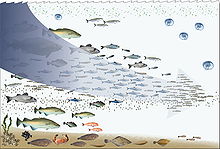
Fisheries direction draws on fisheries science to find ways to protect fishery resources then sustainable exploitation is possible. Mod fisheries direction is oft referred to as a governmental system of (hopefully advisable) management rules based on divers objectives and a mix of direction ways to implement the rules, which are put in place by a arrangement of monitoring control and surveillance.
Fisheries scientific discipline is the academic discipline of managing and understanding fisheries. It is a multidisciplinary science, which draws on the disciplines of oceanography, marine biology, marine conservation, ecology, population dynamics, economics and management in an endeavour to provide an integrated movie of fisheries. In some cases new disciplines have emerged, such as bioeconomics.
Sustainability [edit]
Problems involved in the long term sustainability of fishing include overfishing, by-catch, marine pollution, environmental furnishings of line-fishing, climatic change and fish farming.
Conservation bug are role of marine conservation, and are addressed in fisheries science programs. There is a growing gap betwixt how many fish are available to be caught and humanity's want to catch them, a problem that gets worse equally the earth population grows.
Like to other ecology issues, there tin can be conflict between the fishermen who depend on fishing for their livelihoods and fishery scientists who realise that if future fish populations are to be sustainable then some fisheries must limit fishing or cease operations.
Beast welfare concerns [edit]
Historically, some doubted that fish could experience pain. Laboratory experiments have shown that fish do react to painful stimuli (e.thou., injections of bee venom) in a similar mode to mammals.[37] [38] This is controversial and has been disputed.[ further explanation needed ] [39] The expansion of fish farming likewise equally creature welfare concerns in society has led to research into more humane and faster ways of killing fish.[forty]
In big-calibration operations similar fish farms, stunning fish with electricity or putting them into water saturated with nitrogen then that they cannot breathe, results in decease more apace than just taking them out of the water. For sport fishing, it is recommended that fish be killed soon after communicable them by hitting them on the head followed by bleeding out or past stabbing the brain with a precipitous object[41] (called pithing or ike jime in Japanese). Some believe information technology is non cruel if you release the catch back to where information technology was defenseless however a written report in 2018 states that the hook damages an important role of the feeding mechanism by which the fish sucks in nutrient, ignoring the issue of hurting.[42]
When fishing in that location are high chances of catching other marine wildlife in a fishing net. There are over 100 different fishing regulations on paper for reducing this bycatch. [43]
Plastic pollution [edit]
Abased, lost, or otherwise discarded fishing gear includes netting, mono/multifilament lines, hooks, ropes, floats, buoys, sinkers, anchors, metallic materials and fish aggregating devices (FADs) made of not-biodegradable materials such as physical, metal and polymers. It has been estimated that global angling gear losses each year include 5.7% of all fishing nets, viii.6% of all traps and 29% of all lines used. Abandoned, lost, or otherwise discarded fishing gear (ALDFG) can accept serious impacts on marine organisms through entanglement and ingestion.[44] The potential for fishing gear to go ALDFG depends on a number of factors including:
- Environmental factors are by and large related to seafloor topography and obstructions, although tides, currents, waves, winds, and interaction with wildlife are also of import.
- Operational losses and operator errors can occur fifty-fifty during normal angling operations.
- Problems such as inadequate fisheries management and regulations that do not include acceptable controls can hamper collection of ALDFG (east.g. there may be poor access to collection facilities).
- Gear loss resulting from conflicts primarily occurs (intentionally or unintentionally) in areas with high concentrations of angling activities, leading to gear beingness towed abroad, fouled, sabotaged or vandalized. Passive and unattended gear such as pots, set gillnets and traps are peculiarly prone to conflict damage. In the Arctic, conflicts are the virtually mutual reason for lost gear.[44]
Cultural touch [edit]
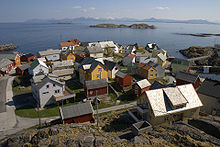
Ona, a traditional fishing hamlet in Norway

Kaibarta woman with traditional fish catching device made from bamboo in Assam
- Community
- For communities like line-fishing villages, fisheries provide not just a source of food and work simply also a community and cultural identity.[45]
- Economic
- Some locations may be regarded every bit fishing destinations, which anglers visit on vacation or for competitions. The economic bear upon of fishing by visitors may be a significant, or fifty-fifty principal commuter of tourism revenue for some destinations.
- Semantic
- A "angling expedition" is a situation where an interviewer implies they know more than they do to trick their target into divulging more information than they wish to reveal. Other examples of fishing terms that bear a negative connotation are: "fishing for compliments", "to be fooled hook, line and sinker" (to be fooled beyond merely "taking the bait"), and the internet scam of phishing, in which a third party will indistinguishable a website where the user would put sensitive information (such every bit depository financial institution codes).
- Religious
- Line-fishing has had an issue on major religions,[46] including Christianity,[47] [48] Hinduism, and the various new age[49] religions. Jesus was said to participate in fishing excursions, and a number of the miracles and many parables and stories reported in the Bible involve fish or fishing. Since the Apostle Peter[l] was a fisherman, the Cosmic Church has adopted the use of the fishermans ring into the Pope's traditional vestments.
See also [edit]
- List of fishing villages
Notes [edit]
- ^ The diction of the following definitions of the fishing industry are based on those used by the Australian government.[35]
References [edit]
- ^ Fisheries and Aquaculture in our Changing Climate Policy brief of the FAO for the UNFCCC COP-15 in Copenhagen, December 2009.
- ^ "Fisheries and Aquaculture". FAO. Retrieved ane July 2012.
- ^ African Bone Tools Dispute Cardinal Idea About Human being Development National Geographic News article. (archived 17 Jan 2006)
- ^ Yaowu Hu, Y; Hong Shang, H; Haowen Tong, H; Olaf Nehlich, O; Wu Liu, Due west; Zhao, C; Yu, J; Wang, C; Trinkaus, E; Richards, M (2009). "Stable isotope dietary analysis of the Tianyuan ane early modernistic human". Proceedings of the National University of Sciences. 106 (27): 10971–74. Bibcode:2009PNAS..10610971H. doi:x.1073/pnas.0904826106. PMC2706269. PMID 19581579.
- ^ First straight show of substantial fish consumption by early on mod humans in China PhysOrg.com, 6 July 2009.
- ^ Littoral Shell Middens and Agronomical Origins in Atlantic Europe.
- ^ "History of angling – fishing nets, shellfish, boats". quatr.us Written report Guides. 12 June 2017. Retrieved 2 May 2018.
- ^ "History of fishing – angling nets, shellfish, boats". quatr.us Study Guides. 12 June 2017. Retrieved two May 2018.
- ^ a b "History of a Brixham trawler". JKappeal.org. ii March 2009. Archived from the original on two December 2010. Retrieved 13 September 2010.
- ^ Days out: "Gone fishing in Grimsby" [ permanent dead link ] The Independent, eight September 2002 [ dead link ]
- ^ "A brief history of Grimsby". localhistories.org. 14 March 2021.
- ^ "Pilgrim'south restoration under total sail". BBC. BBC. Archived from the original on 17 November 2002. Retrieved 2 March 2009.
- ^ Sailing trawlers. issuu.
- ^ "The Steam Trawler".
- ^ a b "HISTORY". Archived from the original on 21 August 2013. Retrieved sixteen July 2014.
- ^ Berners, Dame Juliana (1496) A treatyse of fysshynge wyth an Angle (transcription by Risa S. Bear).
- ^ Berners, Matriarch Juliana. (2008). In Encyclopædia Britannica. Retrieved 20 June 2008, from Encyclopædia Britannica Online
- ^ Andrew N. Herd. "Fly fishing techniques in the fifteenth century".
- ^ Stan L. Ulanski (2003). The Science of Wing-fishing. University of Virginia Press. p. 4. ISBN978-0-8139-2210-2.
- ^ "Welcome To Great Fly Angling Tips". Dec 2011. Archived from the original on 27 June 2017. Retrieved 16 July 2014.
- ^ "Fishing Tackle Affiliate 3" (PDF). Clam PRODUCTIONS. Archived from the original (PDF) on 18 September 2013. Retrieved xvi July 2014.
- ^ a b Andrew N. Herd. "Fly Angling in the Years 1800–1850". Archived from the original on three July 2014. Retrieved 16 July 2014.
- ^ Andrew N. Herd. "Wing Fishing in the Eighteenth Century". Archived from the original on 19 July 2014. Retrieved xvi July 2014.
- ^ a b c "fishing". Encyclopedia Britannica.
- ^ Brown, Jim. A Treasury of Reels: The Line-fishing Reel Collection of The American Museum of Wing Line-fishing. Manchester, Vermont: The American Museum of Fly Angling, 1990.
- ^ Schullery, Paul. The Orvis Story: 150 Years of an American Sporting Tradition. Manchester, Vermont, The Orvis Company, Inc., 2006
- ^ Fishing with a drone Stuff, fifteen December 2015.
- ^ Lennox, Robert J; Alós, Josep; Arlinghaus, Robert; Horodysky, Andrij; Klefoth, Thomas; Monk, Christopher T; Cooke, Steven J (2017). "What makes fish vulnerable to capture by hooks? A conceptual framework and a review of central determinants". Fish and Fisheries. 18 (v): 986–1010. doi:ten.1111/faf.12219. ISSN 1467-2979.
- ^ Keegan, William F (1986) New Serial, Volume. 88, No. one., pp. 92–107.
- ^ a b FAO 2007
- ^ NOAA: Sport line-fishing boat
- ^ FAO. "The office of Recreational Fisheries in the sustainable direction of marine resources | GLOBEFISH | Food and Agriculture Organization of the United Nations". www.fao.org. Food and Agriculture Organization of the United Nations. Retrieved 2 February 2021.
- ^ Lange, David. "Topic: Recreational Fishing in the U.Due south." Statista.
- ^ FAO Fisheries Department: Glossary: Fishing industry. Retrieved 28 May 2008.
- ^ "Today'due south Fishing Industry". Fisheries Research and Development Corporation. 10 December 2007. Archived from the original on 14 June 2009. Retrieved 26 July 2012.
- ^ Tidwell, James H. and Allan, Geoff L.
- ^ Sneddon, LU (2009). "Hurting perception in fish: indicators and endpoints". ILAR Journal. 50 (four): 38–42. doi:ten.1093/ilar.50.4.338. PMID 19949250.
- ^ Oidtmann, B; Hoffman, RW (July–August 2001). "Pain and suffering in fish". Berliner und Münchener Tierärztliche Wochenschrift. 114 (vii–8): 277–282. PMID 11505801.
- ^ "Do fish feel pain? Non every bit humans do, study suggests". ScienceDaily. viii Baronial 2013. Retrieved 2 August 2017.
- ^ Lund, V; Mejdell, CM; Röcklinsberg, H; Anthony, R; Håstein, T (4 May 2007). "Expanding the moral circle: farmed fish equally objects of moral concern". Diseases of Aquatic Organisms. 75 (2): 109–118. doi:10.3354/dao075109. PMID 17578250.
- ^ Davie, PS; Kopf, RK (August 2006). "Physiology, behaviour and welfare of fish during recreational fishing and after release". New Zealand Veterinary Journal. 54 (4): 161–172. doi:ten.1080/00480169.2006.36690. PMID 16915337. S2CID 1636511.
- ^ "Anglers' grab-and-release method stops fish feeding properly, study finds". The Independent. ix Oct 2018. Retrieved 10 October 2018.
- ^ "Facts | Seaspiracy Website". SEASPIRACY . Retrieved 12 March 2022.
- ^ a b Environment, U. Due north. (21 Oct 2021). "Drowning in Plastics – Marine Litter and Plastic Waste Vital Graphics". UNEP - UN Surroundings Programme . Retrieved 23 March 2022.
- ^ "International Commonage in Support of Fishworkers". ICSF. 2 March 2012. Retrieved i July 2012.
- ^ Regensteinn J.Thou. and Regensteinn C.East. (2000) "Religious food laws and the seafood industry" In: R.Due east. Martin, E.P. Carter, G.J. Flick Jr and 50.1000. Davis (Eds) (2000) Marine and freshwater products handbook, CRC Press. ISBN 978-one-56676-889-4.
- ^ A Misunderstood Illustration for Evangelism Bible Analysis Article
- ^ American Bible Club Article Archived 5 September 2008 at the Wayback Machine American Bible Society
- ^ About Pisces the Fish The Astrology Cafe Monitor
- ^ Peter: From Fisherman to Fisher of Men Profiles of Faith Archived half-dozen March 2016 at the Wayback Automobile
Sources [edit]
 This commodity incorporates text from a free content work. Licensed nether Cc By-SA 3.0 IGO License statement/permission. Text taken from Drowning in Plastics – Marine Litter and Plastic Waste product Vital Graphics, United Nations Environment Programme.
Further reading [edit]
- Schultz, Ken (1999). Line-fishing Encyclopedia: Worldwide Fishing Guide . John Wiley & Sons. ISBN978-0-02-862057-two.
- Gabriel, Otto; Andres von Brandt (2005). Fish catching methods of the world. Blackwell. ISBN978-0-85238-280-vi.
- Sahrhage, Dietrich; Johannes Lundbeck (1992). A History of Fishing. Springer-Verlag. ISBN978-0-387-55332-0.
External links [edit]
- "The bounding main without fish, a reality!". Pauly, Daniel (2009). Academy of British Columbia. Archived from the original on vii January 2013. .
- Map of world ocean fishing action, 2016
The Free Encyclopedia
Source: https://en.wikipedia.org/wiki/Fishing

Post a Comment for "United Nation Coastal Fisheries Outrigger Canoe Plan Reviews"