Whats the Sample in East Village Trip by Art Alfie
'Live at the Village Vanguard'
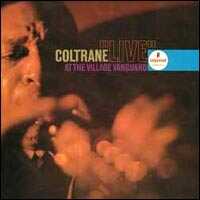
Coltrane'south gear up list in late '61 was a quixotic mix: popular originals ("Naima," simply non "Africa"), recently recorded tunes ("Greensleeves," but oddly not "My Favorite Things"), and new compositions that drew inspiration from foreign sources ("India," "Brasilia"), modal jazz ("Miles' Mode," "Impressions"), and traditional folk songs ("Spiritual"). Engineer Rudy Van Gelder, with mixing panel set atop a commandeered table near the Village Vanguard bandstand, captured it all on record.
The eventual album, released in early 1962, distilled numerous reels of live music downwards to one disc with 3 tracks. "Spiritual" and the standard "Softly, as in a Forenoon Sunrise" constituted Side A, but it was Side B that kickoff drew attention (and derision) and set ears atilt, and for which the album is at present celebrated. Later generations revere "Chasin' the Trane" equally the birth cry of sixties avant-garde jazz: an outpouring of stylistic tongues and melodic ideas that linked the bebop dexterity and daring of the past with a free, stripped-bare, spiritually charged future.
Van Gelder recalls "Chasin'" primarily every bit a challenge, with Coltrane swinging his saxophone and stalking the pocket-sized phase of the basement lodge (hence the title, which the engineer himself suggested). To Coltrane himself it was only an impromptu blues -- no theme, no opening statement, pure solo -- that featured his horn, Jimmy Garrison's bass, and Elvin Jones's drums. It was the first time the bassist had played with the group. And significantly, no pianoforte. "The tune not merely wasn't written out only information technology wasn't conceived before we played information technology. We prepare the tempo and in we went," Coltrane recalled.
The avant-garde firebrand Archie Shepp, a Coltrane acolyte: "I was living in a loft in [New York's] East Village in 1962. I heard my neighbor's record player booming and I knew information technology was Trane. But the piano never came in. Every bit he began to develop the line information technology became clear that the structure wasn't and then apparent and he was playing around with sounds: playing way above the normal scale of the horn, neutral and freak notes, overtones, and and then on. I institute it as shocking a piece of music every bit Stravinsky'south 'Rite of Spring' was in his solar day."
A xv-minute solo on tenor saxophone -- especially in the context of 1961 -- must take seemed at to the lowest degree indulgent. What was Coltrane up to?
"It'due south basically a dejection," Shepp explains. "Merely where the vocal's course is much less important than the tune itself, and the relation between the melody and the rhythm. Sonny Rollins had worked without piano earlier, but his playing was primarily harmonically oriented -- and Ornette Coleman likewise, who was totally aharmonic. Coltrane was able to integrate the two, to put everything in context, in such a sophisticated style that information technology influenced everybody. [Without the piano] it's the signal where the Coltrane Quartet became an avant-garde trio."
Rather than simply a zero hour for gratuitous jazz, Shepp sees the tune more every bit "a synthesis of what came before. You could say that it'southward free jazz, but it's not totally gratis considering at that place are still very strong structural indications: chords, harmony. Trane said that Giant Steps [1959] was sort of the cease of 1 phase where he had exhausted all of the permutations of chords. 'Chasin' the Trane' was another door that opened: the apply of sound for sound itself.
"I think information technology's 1 of the most innovative pieces in the history of African-American improvised music, as important as Charlie Parker'due south 'Ko-Ko' [1945] or Coleman Hawkins' 'Body and Soul' [1939]. That's the greatness of Trane, that he e'er kept the feeling of dance and the spiritual elements so of import to what they used to phone call 'hot jazz.' That's why his peers all respected him and then much, because he didn't throw the baby out with the bathwater."
Critics of the day often diverged in their opinions on Coltrane. Merely in "Double View of Coltrane 'Alive,'" twin reviews in Downwardly Vanquish in April 1962, Ira Gitler and Pete Welding seemed to hold on "Chasin' the Trane." "More like waitin' for a railroad train -- a 100-machine freight train -- to laissez passer," judged the former. "Sputtering inconclusiveness" and "a frenzied sort of soul-baring," wrote the latter.
Present-day judgment has been more generous. To producer Bob Thiele, it was a "musical mega-nova": "Physicists have long debated about the existence of a 'big bang.' Without any question the jazz equivalent occurred during that seismic quarter-hour." Gary Giddins sees in "Chasin'" "one of those crucial performances in which nosotros can hear the subversion of a sensibility and a yearning for new worlds."
Indeed, if it can be said that there was ane moment when Impulse took a leap of faith and yoked its fortune to that drive for the new -- sharing Coltrane's path -- it is here.
From The House That Trane Built: The Story of Impulse Records Copyright © 2006 by Ashley Kahn.
Source: https://www.npr.org/2006/06/06/5452186/impulse-records-the-house-that-trane-built

Post a Comment for "Whats the Sample in East Village Trip by Art Alfie"